 By
By 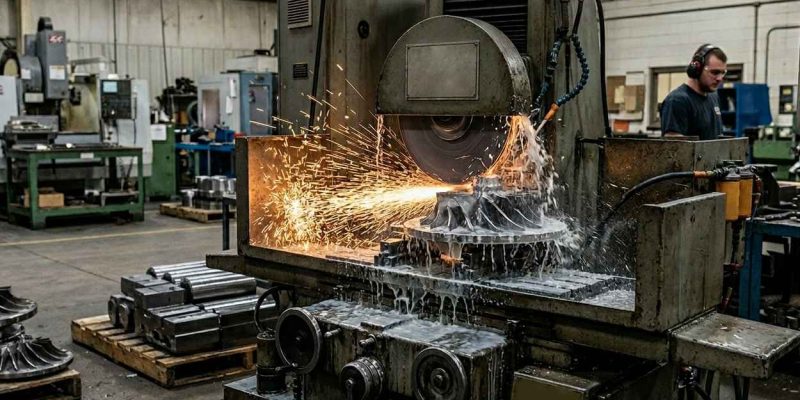
Grinding is one of the most important machining processes used in modern manufacturing to achieve high precision, smooth surface finish, and tight dimensional accuracy. Among the various grinding techniques, conventional grinding and creep feed grinding are two widely used methods that serve different industrial needs.
Although both processes fall under the same category of abrasive machining, they differ significantly in terms of cutting depth, feed rate, productivity, and application areas. Understanding the difference between creep feed grinding vs conventional grinding helps manufacturers choose the right process for better efficiency, cost-effectiveness, and product quality.
What is Conventional Grinding?
Conventional grinding is the most commonly used grinding process in manufacturing industries. In this method, a grinding wheel removes material from the workpiece at a relatively shallow depth and moderate feed rate.
The process involves multiple passes of the grinding wheel over the surface of the material. Each pass removes a small amount of material until the desired shape, dimension, and surface finish are achieved.
Key Characteristics of Conventional Grinding:
- Shallow depth of cut
- Higher wheel speed with moderate feed rate
- Multiple passes required
- Suitable for general-purpose finishing
- Produces good surface finish with controlled accuracy
This method is widely used in tool rooms, automotive components, and general engineering applications where precision is important but extremely high material removal rates are not required.
What is Creep Feed Grinding?
Creep feed grinding is an advanced form of grinding used primarily for heavy material removal in a single pass or very few passes. In this process, the grinding wheel moves slowly over the workpiece at a high depth of cut.
Unlike conventional grinding, creep feed grinding uses a much larger contact area between the wheel and the workpiece, allowing it to remove a significant amount of material in one operation.
Key Characteristics of Creep Feed Grinding:
- Deep cutting depth
- Very slow feed rate (hence the term “creep feed”)
- High material removal per pass
- Often uses specially designed grinding wheels
- Requires powerful and rigid machines
This process is commonly used in aerospace, turbine blade manufacturing, and complex component production where intricate shapes and heavy stock removal are required.
Comparison Table: Creep Feed Grinding vs Conventional Grinding
| Feature | Creep Feed Grinding | Conventional Grinding |
| Process Type | Advanced grinding process designed for high material removal | Traditional abrasive machining method used for finishing operations |
| Material Removal Rate | Very high | Low to moderate |
| Depth of Cut | Deep cutting depth | Shallow cutting depth |
| Feed Rate | Very slow (creep-like movement) | Moderate to high |
| Number of Passes | Single or very few passes | Multiple passes required |
| Cycle Time | Shorter for complex and heavy machining | Longer due to repeated operations |
| Surface Finish Quality | Good to excellent depending on setup | Excellent finish with high precision |
| Machine Requirements | High-power, rigid, and specialized machines | Standard grinding machines |
| Tool/Wheel Wear | Higher wear due to heavy cutting load | Lower wear due to lighter cuts |
| Productivity Level | High productivity for complex components | Moderate productivity |
| Complex Shape Capability | Highly suitable for complex profiles | Limited for complex geometries |
| Typical Applications | Aerospace parts, turbine blades, die & mold manufacturing | Tool sharpening, automotive parts, general engineering components |
Advantages of Conventional Grinding
Conventional grinding remains widely used because of its simplicity and versatility. Some of its major advantages include:
- Suitable for a wide range of materials
- Produces high-quality surface finish
- Lower machine investment cost
- Easy to control and operate
- Ideal for precision finishing work
However, it may not be efficient for large material removal or complex geometries.
Advantages of Creep Feed Grinding
Creep feed grinding is preferred in advanced manufacturing industries due to its unique capabilities:
- Extremely high material removal rate
- Reduces number of machining steps
- Suitable for complex shapes and deep cuts
- Improves productivity for large components
- Can reduce overall production time
Despite these benefits, it requires expensive equipment and careful process control.
Limitations of Both Processes
Conventional Grinding Limitations:
- Low productivity for heavy machining
- Multiple passes increase cycle time
- Not suitable for deep material removal
Creep Feed Grinding Limitations:
- High machine cost
- Requires skilled operation and setup
- Wheel wear can be significant if not managed properly
Applications in Modern Manufacturing
Both grinding processes play a crucial role in different industries:
Conventional Grinding Applications:
- Cutting tool sharpening
- Automotive engine components
- Surface finishing of metal parts
- General engineering workshops
Creep Feed Grinding Applications:
- Aerospace turbine blades
- Gas turbine components
- Complex die and mold manufacturing
- High-performance engineering parts
Which One Should You Choose?
The choice between creep feed grinding vs conventional grinding depends entirely on the application requirements.
- If the goal is fine surface finish and precision with moderate material removal, conventional grinding is the best choice.
- If the requirement involves heavy stock removal, complex geometry, and faster production of hard materials, creep feed grinding is more suitable.
Manufacturers often use both processes at different stages of production to achieve optimal efficiency and quality.
Conclusion
Both conventional grinding and creep feed grinding are essential machining processes in modern manufacturing. While conventional grinding is ideal for precision finishing and general-purpose applications, creep feed grinding excels in high-efficiency material removal and complex component manufacturing.
Understanding the differences between these two methods helps engineers and manufacturers optimize production processes, reduce costs, and improve product quality. Choosing the right grinding technique ultimately depends on material type, design complexity, production volume, and required surface finish.
By selecting the appropriate method, industries can achieve better performance, higher productivity, and superior engineering results.




Comments